Recommended path
Get more value from this case in three moves
Use the case as proof, pair it with strategic framing, then reconnect it to live market movement so the page becomes part of a larger narrative.
01 · Current case
Agentic Data Pipeline With MCP
A next-generation data pipeline where Claude-powered agents connected via Model Context Protocol autonomously detect schema changes, fix data quality issues, reroute failed loads, and report decisions through structur...
02 · Strategic framing
Agentic AI Data Engineering: 2026 Infrastructure Strategy
Translate this implementation proof into executive language, tradeoffs, and a clearer decision story.
03 · Live context
Zero-Downtime Patching in Lakebase Part 1: Prewarming
Bring the case back to the present with a market signal that shows why the architecture still matters now.
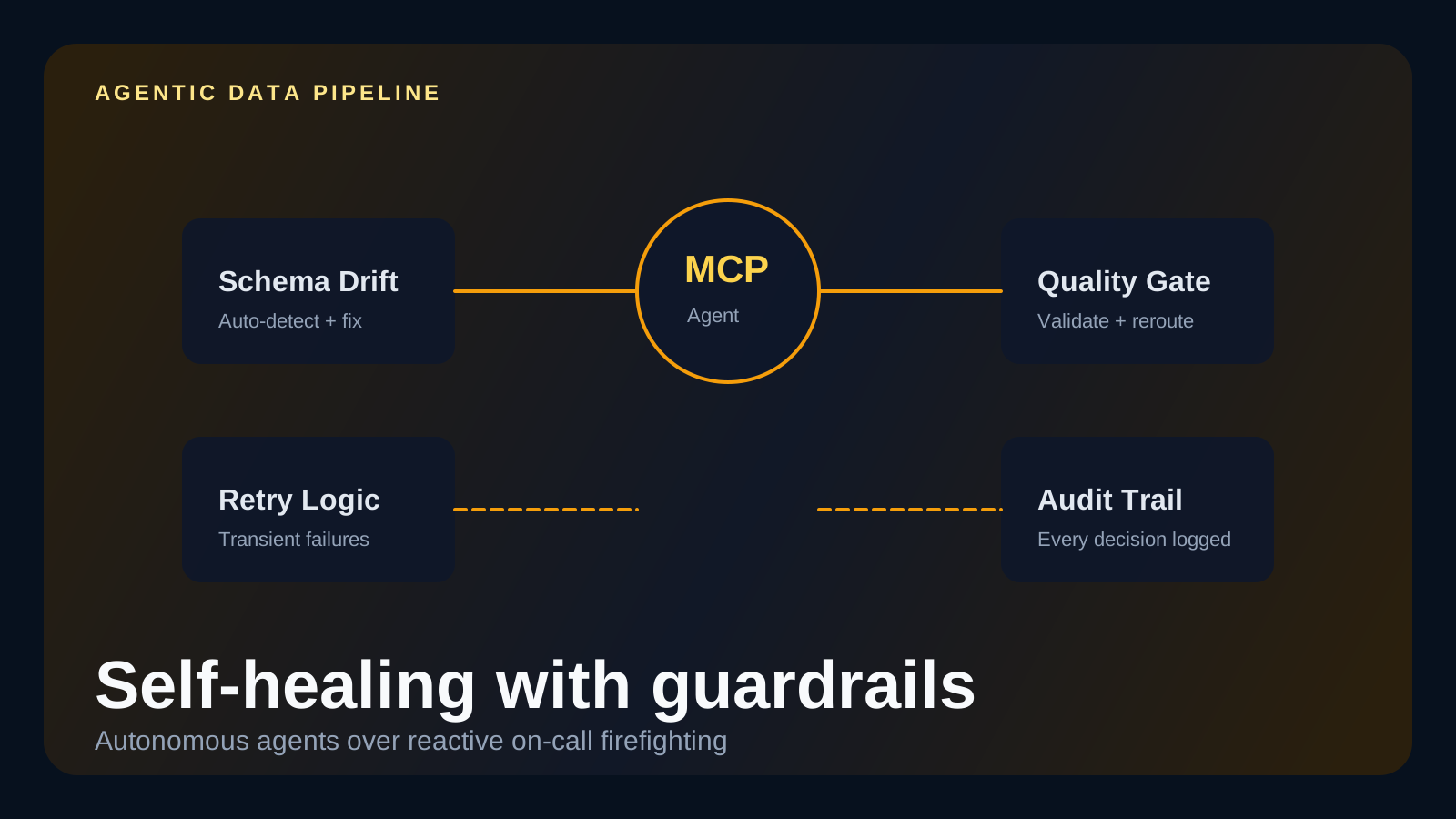
Agentic Data Pipeline With MCP
Autonomous pipeline orchestration where AI agents handle schema drift, quality failures, and routing decisions
The challenge
Traditional pipelines fail silently or require manual intervention when sources change schema, quality degrades, or downstream systems become unavailable. On-call engineers spend nights fixing issues that follow predictable patterns. The operational cost of reactive pipeline maintenance scales linearly with data source count.
How we solved it
- - Deploy MCP-connected agents that monitor pipeline health, detect schema drift, and propose fixes autonomously
- - Use Claude as the reasoning engine with tool-use capabilities to query metadata, run validation, and execute remediation
- - Implement guardrails that require human approval for destructive actions while allowing agents to handle routine fixes independently
- - Log every agent decision with full context in a structured audit trail for compliance and debugging
Execution story
Airflow orchestrates the pipeline stages, but MCP agents sit at decision points where failures typically require human intervention. When an agent detects an anomaly, it gathers context from multiple tools, reasons about the best fix, executes it within defined guardrails, and logs the full decision chain. The result is a pipeline that self-heals for routine issues and escalates intelligently for novel problems.
What this case proves
Agentic AI for data engineering is not about replacing engineers. It is about giving autonomous agents the same context and tools that an on-call engineer would use, then letting them handle the repetitive pattern-matching work that burns out senior people.
Why that matters
The economics of data platform operations do not scale. Every new source, every new downstream consumer, every new SLA adds to the on-call burden. Agents that can detect, diagnose, and fix routine failures change that curve from linear to logarithmic.
Tradeoffs worth calling out
Autonomy without guardrails is dangerous in data infrastructure. This design uses a tiered approval model: agents fix schema drift and retry transient failures independently, but they escalate destructive operations like table drops or backfill rewrites to a human. The guardrails are not a limitation. They are the feature.
Practical takeaway
If your team is exploring agentic AI, this case shows that the highest-value entry point is not a chatbot. It is an autonomous agent embedded at the exact point where your pipeline breaks most often, operating with structured tools and clear boundaries.
Topic cluster
Keep this case alive across strategy and market context
Use the same theme in a new format so technical proof turns into a larger narrative with strategic context and current market movement.
Agentic Data Pipeline with Claude MCP and Data Quality
Build an agentic data pipeline with Claude MCP to automate schema recovery, eliminating on-call triage and improving downstream analytical reliability.
Agentic AI Reshapes Data Engineering Economics and Architecture
Your data platform's cost structure and operational model are about to face scrutiny from business stakeholders armed with cost visibility tools. Simultaneously, the technical foundation you build today must accommoda...
Agentic data pipeline with Claude MCP architecture
Deploy an agentic data pipeline with Claude MCP to resolve schema drift autonomously and eliminate manual recovery tasks on critical infrastructure.
Continue reading
Keep the proof chain moving
Use strategy notes and market signals to turn this technical proof into a stronger narrative for hiring, consulting, or stakeholder conversations.