Recommended path
Get more value from this case in three moves
Use the case as proof, pair it with strategic framing, then reconnect it to live market movement so the page becomes part of a larger narrative.
01 · Current case
GCP Modern Data Stack
A cloud-native analytics workflow that provisions BigQuery and storage with Terraform, ingests market data with Python, and tests warehouse models with dbt and GitHub Actions.
02 · Strategic framing
Data Platform Modernization Patterns Beyond Tool Migration
Translate this implementation proof into executive language, tradeoffs, and a clearer decision story.
03 · Live context
dbt's evolution keeps analytics engineering in the platform spotlight
Bring the case back to the present with a market signal that shows why the architecture still matters now.
GCP Modern Data Stack
Warehouse-oriented analytics engineering on BigQuery
The challenge
Warehouse work often decays into undocumented SQL and manual cloud setup. That slows onboarding, weakens trust in the numbers, and makes every model change feel riskier than it should.
How we solved it
- - Provision GCP storage and BigQuery resources with Terraform
- - Extract and load market-style source data with Python into cloud storage and analytics layers
- - Model staging and mart transformations in dbt with tests around key assumptions
- - Use GitHub Actions to reinforce repeatable validation before changes move forward
Execution story
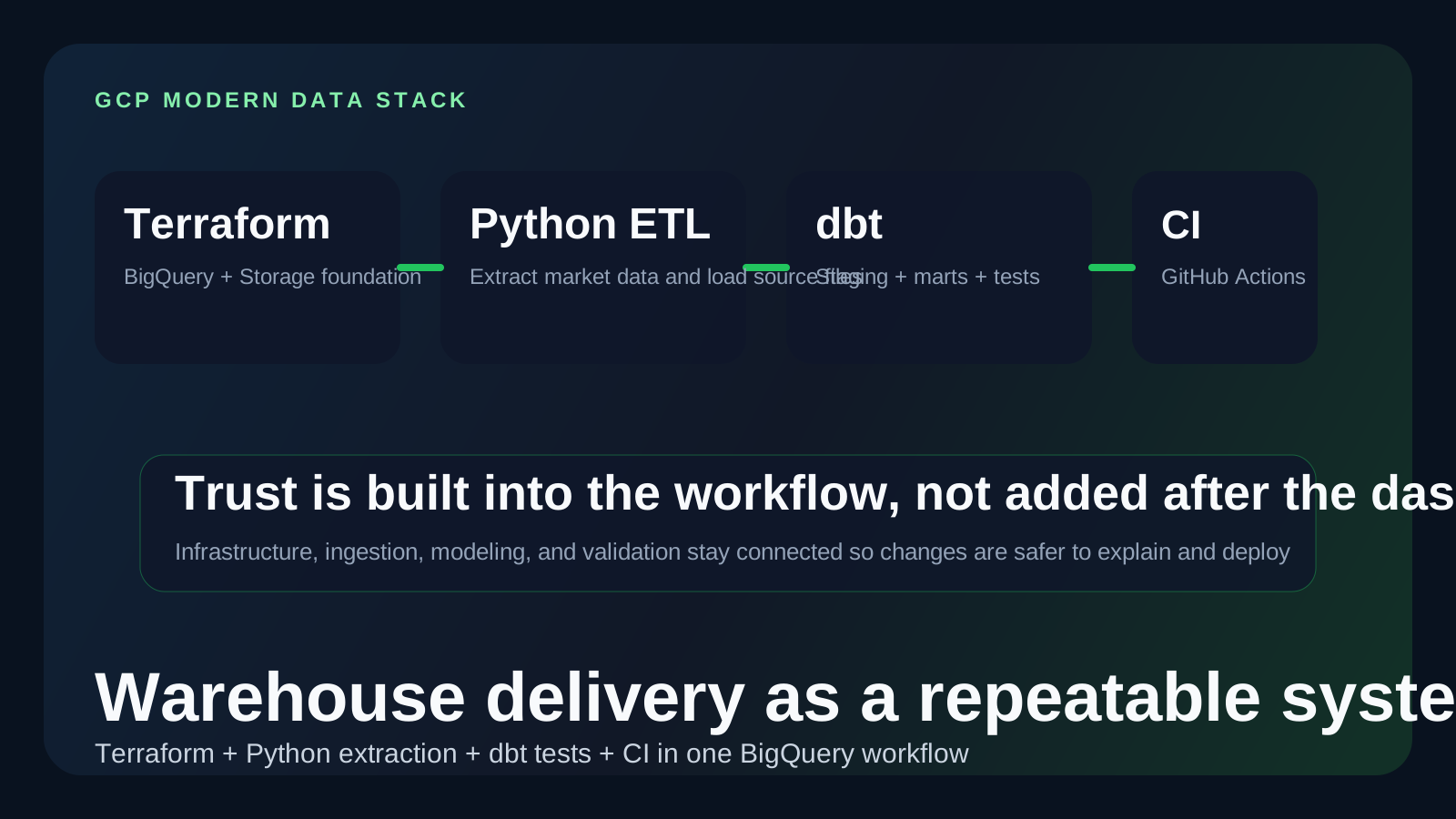
Infrastructure, ingestion, modeling, and validation are all first-class parts of the same workflow. Terraform creates the base, Python handles extract and load, dbt shapes and tests the warehouse models, and CI closes the loop.
What this case proves
This repo treats analytics engineering as delivery, not as scattered SQL. You can trace the path from Terraform-managed cloud resources to Python-based extraction, from loaded source data to dbt staging and mart models, and from there to repeatable validation in GitHub Actions.
Why that matters
The business payoff is trust and speed. When warehouse resources, ingestion logic, and dbt tests live in one coherent flow, change becomes safer. That reduces the drag of undocumented transformations and gives downstream teams a clearer contract.
Tradeoffs worth calling out
The demo path keeps credentials and execution simple enough to run locally. That is useful for a portfolio project, but the production upgrade is obvious: workload identity, richer freshness coverage, environment separation, and deeper observability. The important part is that the repo already exposes where each of those concerns belongs.
Practical takeaway
If the goal is to show you can operate beyond SQL alone, this case works because it joins platform setup, ingestion, dbt modeling, and CI into one concrete warehouse story.
Topic cluster
Keep this case alive across strategy and market context
Use the same theme in a new format so technical proof turns into a larger narrative with strategic context and current market movement.
dbt's evolution keeps analytics engineering in the platform spotlight
This matters because analytics is increasingly judged on reliability and governance, not just dashboard output. Teams that treat transformation as a strategic layer improve trust, delivery quality, and long-term platf...
Data Platform Modernization Patterns Beyond Tool Migration
Move beyond tool migration with data platform modernization patterns that separate responsibilities, ensure auditable transformations, and deliver reliable data freshness to the...
Data movement patterns explained (ETL, ELT, CDC & more)
This matters because reliable transformation is becoming a strategic layer in analytics delivery, improving trust, reuse, and the quality of business-facing data products.
Continue reading
Keep the proof chain moving
Use strategy notes and market signals to turn this technical proof into a stronger narrative for hiring, consulting, or stakeholder conversations.