Recommended path
Get more value from this case in three moves
Use the case as proof, pair it with strategic framing, then reconnect it to live market movement so the page becomes part of a larger narrative.
01 · Current case
RAG Knowledge Base Pipeline
A retrieval-augmented generation pipeline that ingests enterprise documents, chunks and embeds them into pgvector, and serves grounded answers through a FastAPI service backed by Claude.
02 · Strategic framing
Data Engineering and AI Business Value: The Four-Part Test
Translate this implementation proof into executive language, tradeoffs, and a clearer decision story.
03 · Live context
Zero-Downtime Patching in Lakebase Part 1: Prewarming
Bring the case back to the present with a market signal that shows why the architecture still matters now.
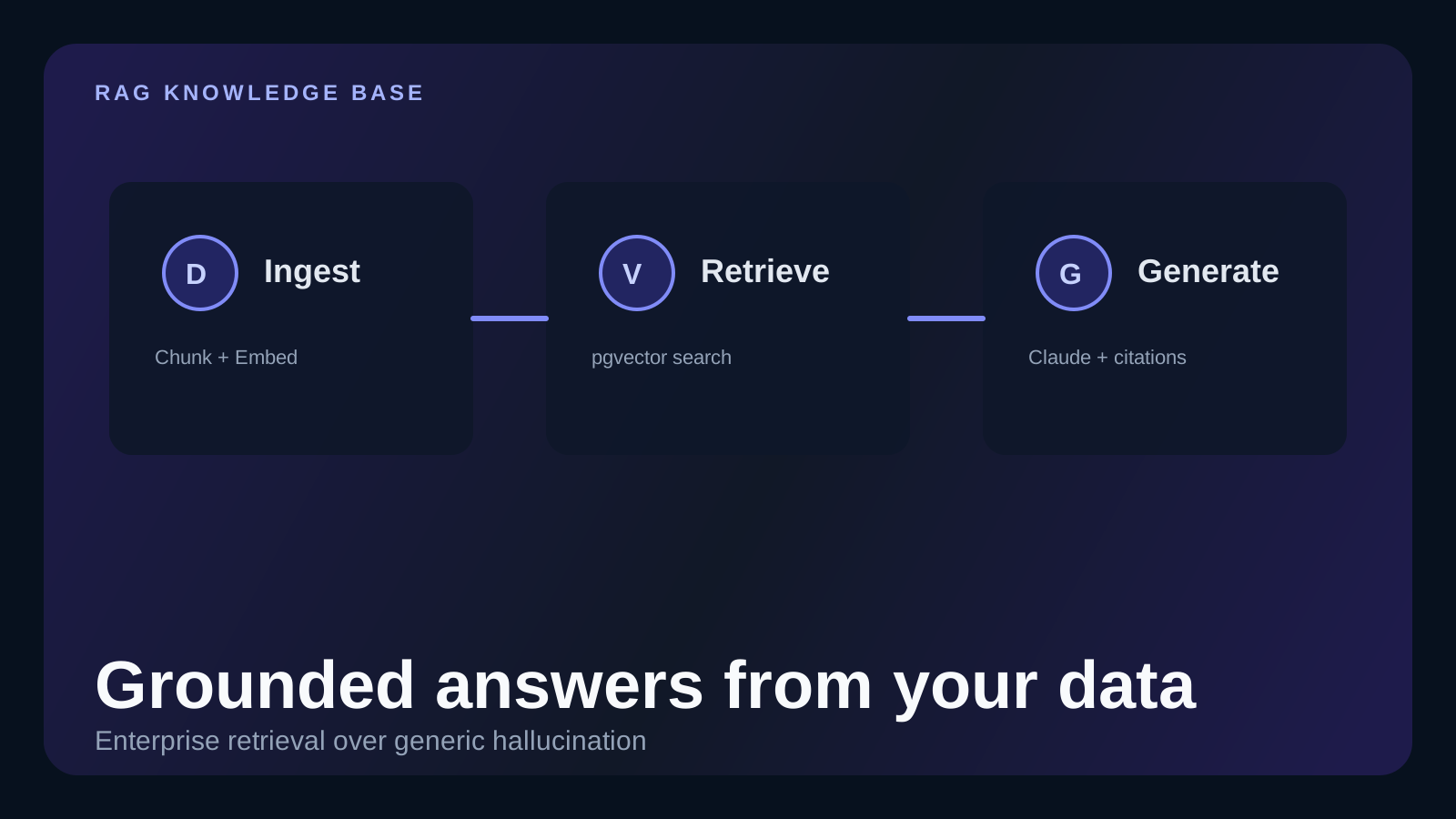
RAG Knowledge Base Pipeline
Enterprise document retrieval with vector search and grounded LLM answers
The challenge
Enterprise knowledge is trapped in PDFs, Confluence pages, and Slack threads. Employees spend hours searching for answers that already exist somewhere in the organization. Generic LLMs hallucinate when asked domain-specific questions without access to internal context.
How we solved it
- - Ingest documents from multiple sources with format-aware chunking that preserves context boundaries
- - Generate embeddings and store them in pgvector with metadata filters for source, date, and topic
- - Serve a retrieval API through FastAPI that finds the most relevant chunks before sending context to Claude
- - Return grounded answers with source citations so users can verify every claim against the original document
Execution story
The pipeline separates ingestion, embedding, retrieval, and generation into distinct stages. PostgreSQL with pgvector handles both structured metadata and vector similarity search in a single database. FastAPI orchestrates the retrieval-then-generate pattern, and Claude produces answers that are grounded in retrieved context rather than parametric memory alone.
What this case proves
RAG is not an AI feature. It is a data engineering problem disguised as an AI feature. The hard part is not calling an LLM. The hard part is building a pipeline that ingests messy enterprise documents, chunks them intelligently, embeds them consistently, retrieves the right context under latency constraints, and does all of that reliably in production.
Why that matters
Every company that adopts AI assistants will eventually need this pipeline. The difference between a demo that impresses and a product that ships is the engineering underneath: chunking strategy, embedding freshness, retrieval precision, and citation traceability.
Tradeoffs worth calling out
Using pgvector instead of a specialized vector database trades some query performance at extreme scale for operational simplicity. For most enterprise knowledge bases under a few million chunks, PostgreSQL handles both relational metadata and vector search without adding another system to the stack.
Practical takeaway
If your team is evaluating RAG, this case gives you a production-ready blueprint that separates concerns cleanly and avoids vendor lock-in on the vector layer.
Topic cluster
Keep this case alive across strategy and market context
Use the same theme in a new format so technical proof turns into a larger narrative with strategic context and current market movement.
Governed AI Analytics Requires Strong Data Engineering
Build governed AI analytics on contracts and metadata to turn text-to-SQL and copilots from demos into production products. Learn the engineering path to trustworthy AI.
Kubernetes as AI Infrastructure: Google Cloud, llm-d, and the CNCF
This matters because modern data teams are expected to simplify tooling, govern transformation, and deliver analytical products faster with less operational overhead.
Agentic Data Pipeline with MCP: Implementing Self-Healing
Implement an agentic data pipeline with MCP to automate schema drift detection and error recovery. Reduce operational overhead and manual on-call interventions.
Continue reading
Keep the proof chain moving
Use strategy notes and market signals to turn this technical proof into a stronger narrative for hiring, consulting, or stakeholder conversations.