Recommended path
Get more value from this case in three moves
Use the case as proof, pair it with strategic framing, then reconnect it to live market movement so the page becomes part of a larger narrative.
01 · Current case
Streaming Radar API
An event-driven serving path where Kafka carries market-style events, Redis holds current state, and FastAPI exposes low-latency endpoints for live consumption.
02 · Strategic framing
Data Engineering and AI Business Value: The Four-Part Test
Translate this implementation proof into executive language, tradeoffs, and a clearer decision story.
03 · Live context
Streaming conversations are moving from speed alone to trustworthy operations
Bring the case back to the present with a market signal that shows why the architecture still matters now.
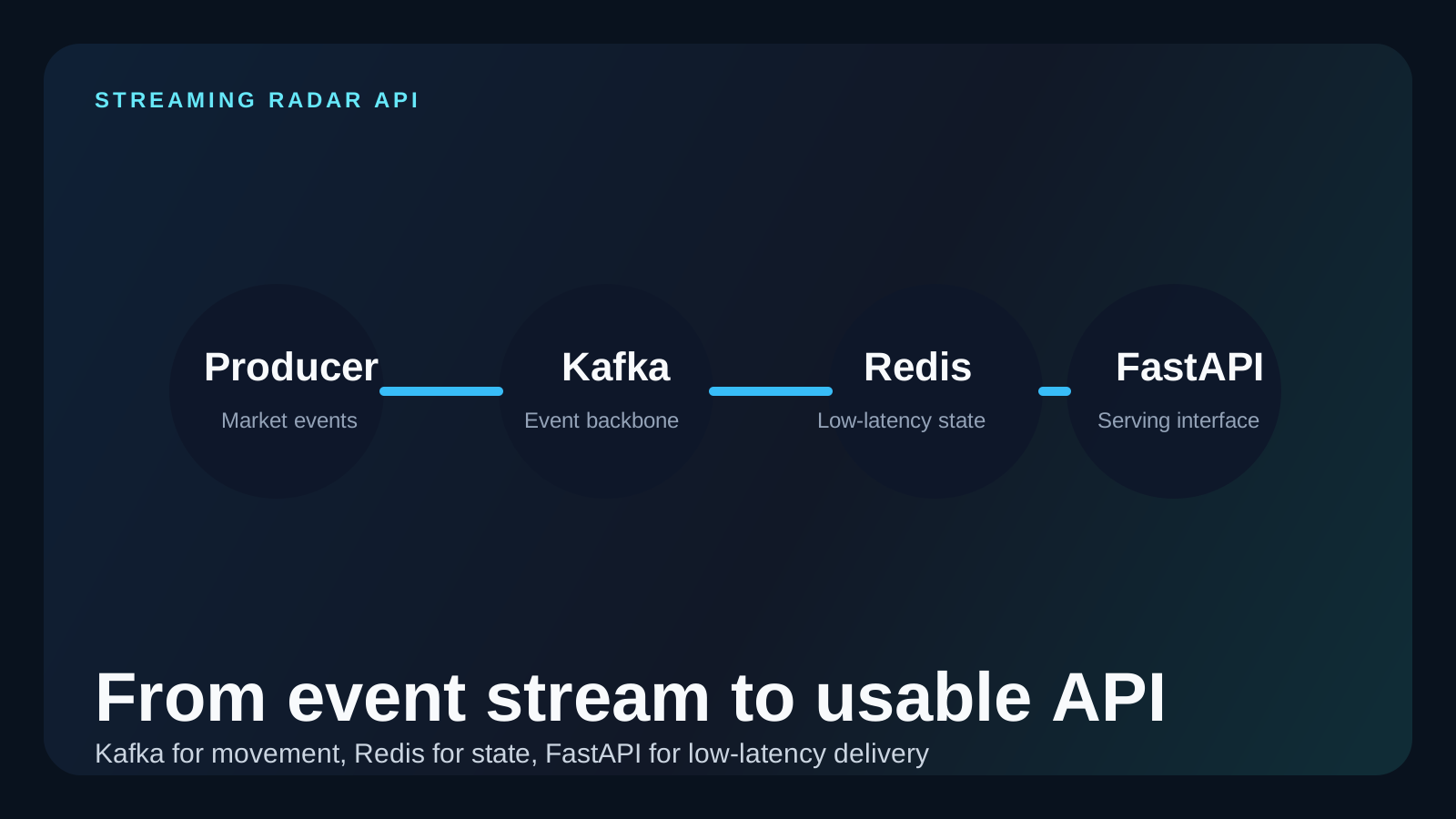
Streaming Radar API
Event-driven serving path from Kafka to low-latency APIs
The challenge
Some systems lose value the moment data arrives after the user decision. The challenge is not only consuming events fast; it is separating ingestion, state, and API delivery so the system stays explainable under pressure.
How we solved it
- - Use Kafka and Zookeeper as the streaming backbone for producer and consumer services
- - Process incoming events through Python services that keep the event path explicit
- - Store low-latency serving state in Redis instead of recomputing every request
- - Expose the latest ticker and history through FastAPI and local Swagger endpoints
Execution story
Producer -> Kafka -> consumer -> Redis -> FastAPI. The architecture is intentionally compact so the low-latency serving pattern stays visible, testable, and easy to explain.
What this case proves
This project shows a practical serving architecture for live data. Kafka carries the event stream, Python services keep the processing steps visible, Redis stores the latest state for fast lookup, and FastAPI turns that state into an interface a downstream app could consume immediately.
Why the separation matters
A common mistake in real-time systems is to blur ingestion, transformation, and serving into one opaque service. This repo does the opposite. Each role stays small and observable, which makes the low-latency claim more credible.
Tradeoffs worth calling out
The system is intentionally compact and local-first. That keeps the learning curve low, but production would need stronger durability, replay strategy, auth, rate limiting, and lag monitoring. The point of the portfolio case is to make the architecture discussable, not to pretend the demo is already a managed platform.
Practical takeaway
If the business needs data while it still matters, this case helps explain how event streaming becomes a usable API instead of a queue no one outside engineering can benefit from.
Topic cluster
Keep this case alive across strategy and market context
Use the same theme in a new format so technical proof turns into a larger narrative with strategic context and current market movement.
Confluent Cloud for Government Achieves FedRAMP Moderate: Mission-Ready Data Streaming for Federal Agencies
This matters because streaming is only strategically valuable when faster operational data improves visibility, responsiveness, and confidence in downstream decisions.
CDC Streaming Architecture for Trustworthy Operational Analytics
Learn CDC streaming architecture patterns that deliver trustworthy operational analytics. Move beyond speed demos to build explainable, real-time data pipelines you can trust in...
Confluent Cloud’s Path to Post-Quantum Cryptography
This matters because streaming is only strategically valuable when faster operational data improves visibility, responsiveness, and confidence in downstream decisions.
Continue reading
Keep the proof chain moving
Use strategy notes and market signals to turn this technical proof into a stronger narrative for hiring, consulting, or stakeholder conversations.